Computer monitors can’t convey all the colour gamut that humans are capable of seeing. Sometimes different monitors display colours differently. Also, the number of colours displayed can vary.
In this topic, we’re going to talk about how colours are formed, and the difference in the colours monitors display from all the colours we can see.
Colour model
Colours can be described using a set of numbers or, in other words, colour coordinates. A mathematical model for describing colours using coordinates is called a colour model. It defines the principle of colour formation, the units of measurement, and the boundaries of the scales.
Coordinate systems can be rectangular, cylindrical, spherical, and so on.
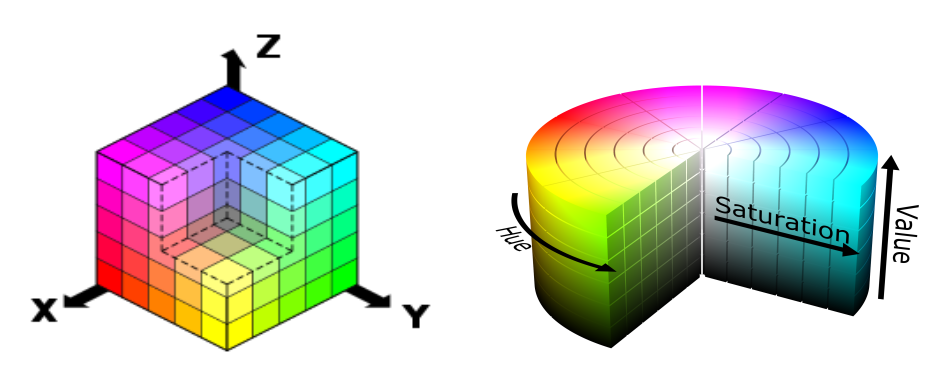
Classification of colour models
Colour models can be conditionally divided into three types:
- Additive models are usually used to produce colour on a monitor. In them, new colours are obtained by adding a primary colour to black. The greater the intensity of the added colour, the closer the resulting colour is to white. Mixing all primary colours results in white if their intensity values are maximal, and black if their intensity values are zero. An example of an additive model is RGB.
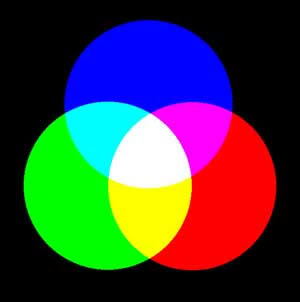
- Subtractive models are mostly used in printing. In them, the primary colours are subtracted from white to get all the other colours. The greater the intensity of the subtracted colour, the closer the resulting colour is to black. Mixing all primary colours gives black when the intensity value is maximal, and white when the intensity value is zero. Examples of such a model are CMY, CMYK.

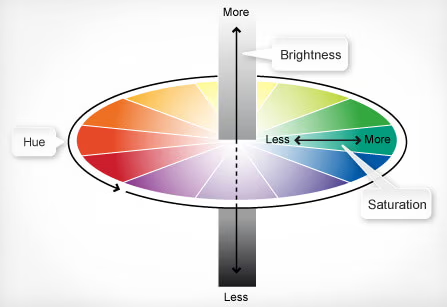
- Perceptual models take into account human vision rather than the technical characteristics of the device. Their main feature is the separation of colour and brightness. Examples of such a model are Hue, Saturation, Lightness (HSL), and Hue, Saturation, Brightness (HSB).
Transclude of perceptual-model.avif
Colour space
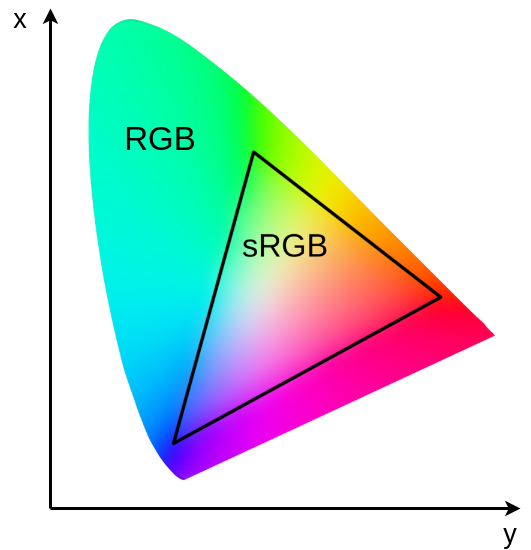
Since device screens cannot reproduce the entire spectrum of possible colours, it became necessary to somehow highlight and indicate these “limitations”. There is such a thing as a colour space for this.
A colour space defines the range of available colours in the chosen colour model. For instance, sRGB is the colour space of the RGB colour model.
Primary
You can often hear the informal term “colour space” used to refer to a colour model. It’s not quite correct, but one might say, it’s partially established in speech.
Conclusion
To summarize, in this topic you’ve learned what a colour model and colour space are. The colour model defines the colour gamut of human vision. In contrast, colour space tells us about the colour gamut available to monitors. Colour models are conventionally divided into:
- Additive, mainly used to produce colours on monitors;
- Subtractive, which are often used in printing;
- Perceptual, which are based on the principles of colour perception by the human eye.